Winning with OpenRouter: The Advantages of a Unified AI Model Gateway
OpenRouter turns a fragmented landscape of AI providers into a single, OpenAI-compatible API. One integration, automatic fallbacks, cross-provider price optimization, multimodal access, and custom data policies — here are the key wins developers and organizations get from a unified AI model gateway.
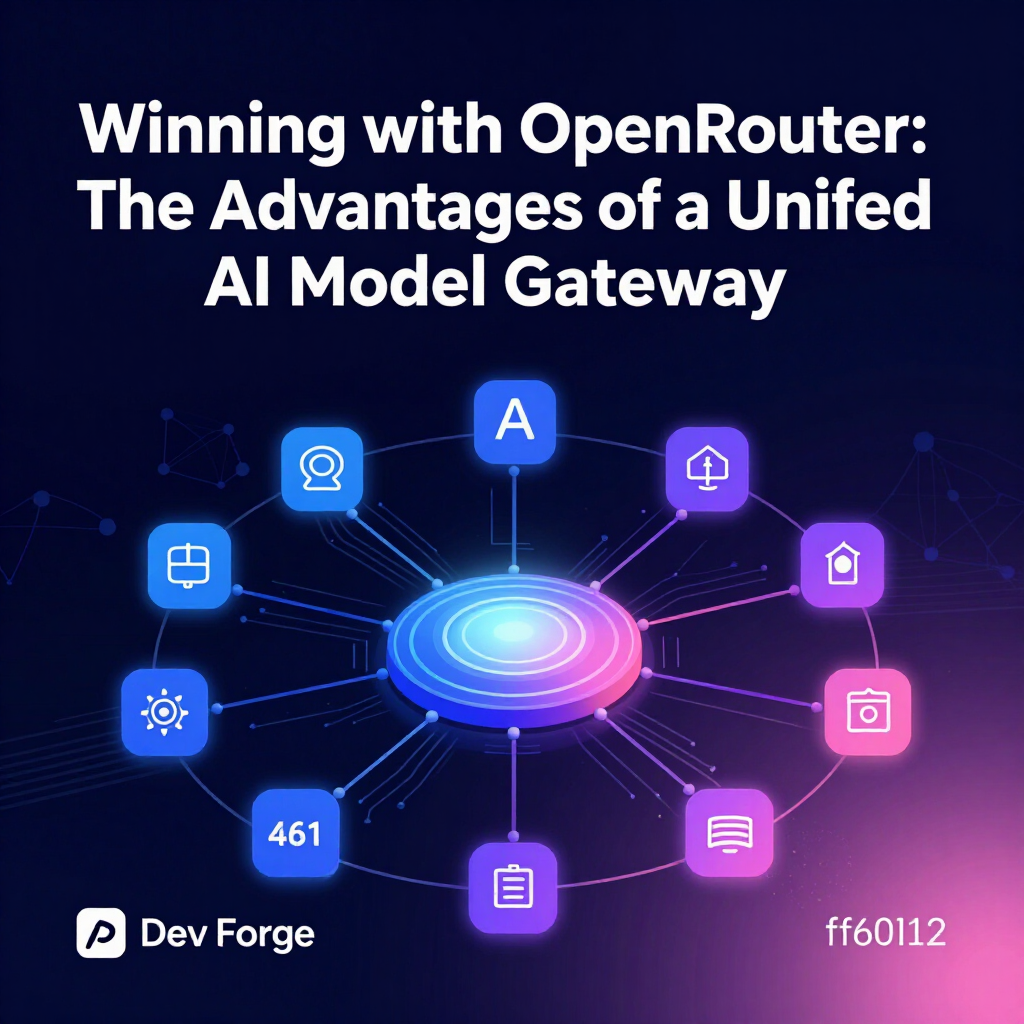
Building applications with large language models used to mean picking one provider, locking into their API, and hoping they stayed reliable, affordable, and best-in-class. OpenRouter changes that equation. It positions itself as a unified interface for every model — a single gateway that connects your application to hundreds of AI models from dozens of providers through one consistent, OpenAI-compatible API. Here's a look at the key wins developers and organizations get from using it.
What OpenRouter Is
At its core, OpenRouter is an aggregation layer that sits between your application and the world of AI providers. Instead of integrating separately with OpenAI, Anthropic, Google, Meta, Mistral, and others, you integrate once with OpenRouter and gain access to their models through a single endpoint. The platform advertises access to 500+ models across 80+ providers, serving 10M+ global users and processing enormous volumes of traffic — a scale that reflects how central this "one interface for everything" approach has become for AI builders.
Win #1: One Integration, Every Model
The biggest and most immediate win is simplicity. With one API key and one integration — fully compatible with the OpenAI API format — you can call models from many different companies. This means:
No juggling multiple SDKs, authentication schemes, and billing relationships.
Switching from one model to another is often as simple as changing a single string in your request.
New models become available to you without new integration work.
For teams that want to experiment freely or stay flexible, this eliminates a huge amount of engineering overhead.
Win #2: Higher Reliability Through Fallbacks
Any single AI provider can experience downtime, rate limits, or degraded performance. OpenRouter's distributed infrastructure allows requests to fall back to alternate providers when one goes down. This uptime optimization means your application can keep serving users even when a specific provider is having problems — turning what would be an outage into a seamless switch behind the scenes. For production applications where availability matters, this resilience is a significant advantage over depending on one vendor.
Win #3: Price and Performance Optimization
OpenRouter lets you compare models and prices across providers so you can find the best fit for each prompt — balancing cost against capability. Because the platform runs inference at the edge, it aims to minimize latency between your users and the models they are calling. In practice, this means you can:
Route expensive, complex tasks to premium models and cheaper, routine tasks to budget models.
Avoid overpaying by choosing the most cost-effective provider for a given model.
Keep response times fast without sacrificing quality.
This flexibility helps teams keep costs under control while still delivering strong performance.
Win #4: Access to Many Modalities
OpenRouter isn't limited to text. It supports generating text, images, video, and audio through the same unified interface. As AI applications increasingly combine modalities — a chatbot that also generates images, or a tool that processes audio and returns text — having them all behind one gateway simplifies building multimodal products without stitching together separate services.
Win #5: Custom Data Policies and Privacy Controls
For organizations handling sensitive information, OpenRouter offers fine-grained data policies. You can control which models and providers your prompts are allowed to reach, ensuring data only goes to systems you trust. This is especially valuable for enterprises with compliance requirements or strict internal rules about where their data can be processed, giving them the benefits of model diversity without giving up control over data flow.
Win #6: Fast, Low-Friction Onboarding
Getting started is designed to be quick: create an account (including options like Google, GitHub, or other sign-ins), buy credits that work across any model or provider, and generate an API key to begin making requests. Because credits are universal across the platform, you don't need separate billing arrangements with each provider — a single balance covers everything you use.
Win #7: A Thriving Ecosystem
OpenRouter reports that hundreds of thousands of apps are built on top of it, serving millions of users, including well-known tools in the developer and agent space. This large ecosystem signals maturity and reliability, and it also means a strong community, documentation, and integrations with popular development tools. Building on a widely adopted platform reduces risk and makes it easier to find help and examples.
When OpenRouter Makes the Most Sense
OpenRouter's advantages are most compelling when:
You want to compare or A/B test multiple models without multiple integrations.
Reliability and uptime are critical, and provider fallback adds real value.
You care about optimizing cost per task across a range of workloads.
You're building multimodal applications.
You need centralized control over data policies and spending.
For a project committed to a single provider forever, a direct integration might be marginally simpler. But for almost any team that values flexibility, resilience, and choice, the aggregation model offers clear benefits.
Conclusion
The central win with OpenRouter is that it turns a fragmented landscape of AI providers into a single, coherent interface. Instead of betting on one model or one vendor, developers gain the freedom to choose the right model for each job, the resilience of automatic fallbacks, the economics of cross-provider price comparison, and the control of custom data policies — all through one integration. In a fast-moving AI ecosystem where new models launch constantly and no single provider stays ahead forever, that flexibility is exactly what lets teams keep winning as the landscape shifts.