LLM Reasoning and Test-Time Compute: A New Axis for Scaling Intelligence
For years, the story of large language model progress was a story about training: bigger models, bigger datasets, bigger clusters. That story now shares the stage with a different idea — one that doesn't touch the model's weights at all. Instead of asking how to build a smarter model, it asks how to let an existing model think longer, and think better, before it answers. That idea is test-time compute, and it has become one of the defining themes in LLM research.
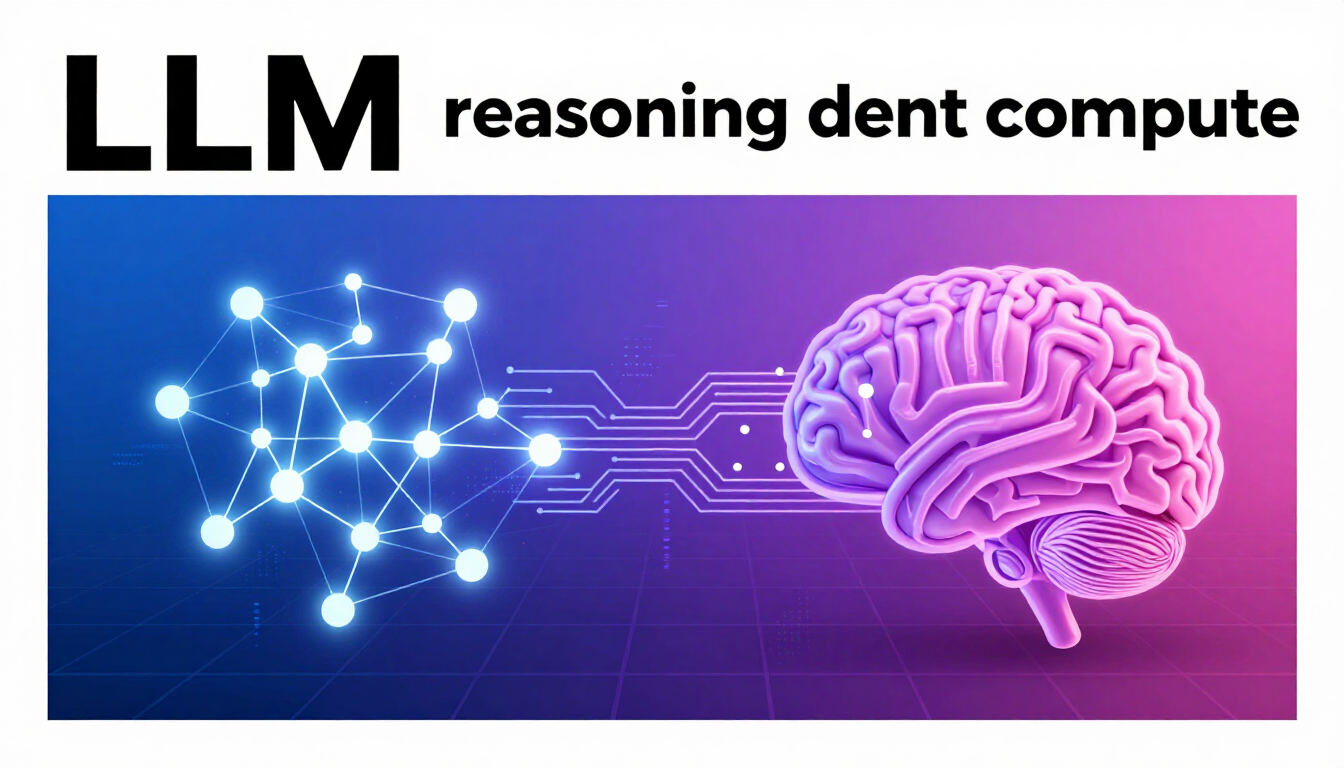
For years, the story of large language model progress was a story about training: bigger models, bigger datasets, bigger clusters. If you wanted a smarter model, you trained a bigger one. That story hasn't disappeared, but it now shares the stage with a different idea — one that doesn't touch the model's weights at all. Instead of asking "how do we build a smarter model," it asks "how do we let an existing model think longer, and think better, before it answers?" That idea is test-time compute, and it has become one of the defining themes in LLM research.
What Test-Time Compute Actually Means
Every time a model generates a response, it spends some amount of computation doing so. Traditionally, that amount was fixed and small: read the prompt, produce an answer, done. Test-time compute (also called inference-time compute) is the practice of deliberately spending more computation at this stage — generating longer reasoning traces, exploring multiple candidate solutions, checking and revising work — in order to get a better answer to a single query.
The intuition maps neatly onto a distinction popularized by psychologist Daniel Kahneman and now widely borrowed in the reasoning-model literature: System 1 versus System 2 thinking. System 1 is fast, intuitive, pattern-matched — the kind of response a model produces in one forward pass. System 2 is slow, deliberate, and effortful — working through a problem step by step, checking intermediate conclusions, backtracking when something doesn't add up. Classic LLMs were built almost entirely as System 1 machines. Test-time compute is the mechanism by which they're being taught System 2 habits.
From Chain-of-Thought to Search
The earliest and simplest version of this idea is chain-of-thought (CoT) prompting: asking a model to "think step by step" rather than jumping straight to an answer. Just externalizing the intermediate steps as text turns out to meaningfully improve performance on tasks that require multi-step logic, especially math and symbolic reasoning.
From there, researchers built increasingly structured ways of spending extra compute:
Self-consistency / sampling and voting — generate many independent reasoning chains for the same problem and take the majority answer, rather than trusting a single attempt.
Tree-of-thought and forest-of-thought search — instead of one linear chain, explore a branching tree of partial solutions, pruning weak branches and expanding promising ones.
Process reward models (PRMs) — rather than only scoring the final answer, train a model to evaluate each intermediate reasoning step, giving the system feedback on how it's reasoning, not just whether it landed on the right answer.
Verification and scrutiny passes — have the model (or a separate verifier) double-check a candidate answer before committing to it, catching arithmetic slips or logical gaps.
A key research finding that helped crystallize this whole direction was the observation that scaling test-time compute optimally can, on some tasks, be more effective than scaling model parameters — meaning a smaller model that "thinks" longer can beat a larger model that answers immediately. This reframed inference-time compute as a genuine second axis of scaling, alongside the traditional axis of pretraining compute.
The Rise of Dedicated "Reasoning Models"
The next step was to stop treating extended thinking as a prompting trick and start building it into training itself. This is the lineage that produced what the field now calls "large reasoning models" — starting with OpenAI's o1 and followed by a wave of systems (DeepSeek-R1 and others) trained explicitly, often with reinforcement learning on verifiable rewards (RLVR), to produce long internal reasoning traces before answering.
Anthropic's Claude models offer an analogous capability through extended thinking modes, where the model is given a larger budget to reason through a problem internally before producing a final response. This kind of "deep reasoning" toggle — a slower, more deliberate mode available for harder queries — has become common across frontier assistants, and is increasingly offered as a distinct tier in consumer products.
Under the hood, these systems are trained so that longer, self-correcting reasoning traces are directly rewarded, teaching the model habits like re-checking its own work, catching an error mid-derivation, or abandoning an unpromising line of reasoning — behaviors that used to require external scaffolding (like tree search) are increasingly learned and internalized by the model itself.
It's Not a Free Lunch
Test-time compute buys real gains, but the research over the past two years has also mapped out its limits and failure modes carefully:
Diminishing and sometimes inverse returns. More thinking doesn't always help — and on some tasks, it can actively hurt. Work on "inverse scaling in test-time compute" has documented cases where longer reasoning chains lead a model away from the correct answer, for instance by overthinking a problem that had a simple solution, or by drifting into spurious reasoning paths.
Confidence miscalibration. Extended reasoning can also distort how confident a model appears — some studies find that over-reasoning impairs a model's confidence calibration, meaning verbose deliberation doesn't necessarily correlate with the model actually being more likely to be right.
Cost and latency. Every extra reasoning token has to be generated and paid for. This creates a genuine efficiency frontier — a Pareto trade-off between accuracy and inference cost — that matters enormously for anyone deploying these systems at scale. Techniques like early-exit strategies and reinforcement learning methods that explicitly control how long a model thinks (rewarding it for being concise when a problem is easy) are direct responses to this cost problem.
Domain dependence. The benefit of chain-of-thought and extended reasoning is not uniform. Evidence suggests it helps mainly on math and symbolic reasoning tasks, with much smaller (or negligible) gains elsewhere — meaning "just let it think longer" is not a universal fix.
Multi-turn and long-horizon fragility. As reasoning and agentic tasks stretch across longer horizons and more conversational turns, models can still "get lost" — losing track of context or earlier commitments even with more compute available to them.
Why This Matters Beyond Benchmarks
Test-time compute is reshaping more than leaderboard scores. A few implications stand out:
A new deployment lever. Because it doesn't require retraining, test-time compute gives developers and end users a dial they can turn at inference time — spend more compute (and money, and latency) on the queries that need it, and less on the ones that don't. This is why "reasoning effort" settings are becoming a standard control surface in APIs and products.
Agentic capability. Long-horizon agents — models that plan, use tools, and act over extended sequences of steps — depend heavily on the ability to reason, verify, and course-correct along the way. Test-time compute techniques are foundational to making agents more reliable, and researchers now track metrics like the length of task ("time horizon") a model can reliably complete as a proxy for this kind of capability.
A rethinking of what "reasoning" means in neural systems. Scaling intelligence at inference time — via chains of thought, search trees, and self-verification passes — reframes intelligence as something that can be spent on demand, not just baked in during training. That's a genuinely different paradigm from the pretraining-scaling story that dominated the field for most of the 2020s, and researchers increasingly view it as one of the more consequential shifts in the field heading toward 2027–2028.
The Open Questions
The field hasn't settled the core questions yet. How do we build verifiers reliable enough to trust for open-ended, non-verifiable tasks (as opposed to math and code, where checking an answer is comparatively easy)? How do we prevent models from confidently overthinking their way to a wrong answer? How do we make long reasoning traces cheap and fast enough for real-time products? And philosophically: does a longer chain-of-thought reflect genuine step-by-step reasoning, or is it sometimes a plausible-looking narrative generated after the fact — a question with real consequences for how much we should trust a model's stated reasoning as an explanation of its actual behavior?
What's clear is that test-time compute has moved from a clever prompting trick to a first-class design axis for language models — one that sits alongside pretraining scale, architecture, and data quality as a lever developers actively tune. The models that impress people most today aren't just bigger; increasingly, they're the ones that know how to spend their thinking time well.
This article reflects research and developments through mid-2026, drawing on work from Anthropic, OpenAI, Google DeepMind, and the broader academic literature on test-time scaling.